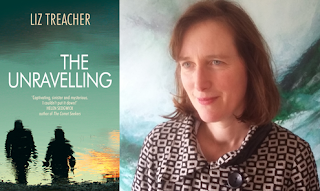
Author interview:
UPDATE 3/3/2023 - this post won a Most Popular Authors Award
I met Liz many moons ago, when we talked of being
writers (one day!) and I’m delighted that Liz achieved her dream in 2017. The
author of three books to date, she delights readers in the genres of
Speculative, Dystopian and Women’s fiction and Romantic Comedies.
Of herself, she says, ‘I am a writer and an art
photographer. I am married with two children and live in the Highlands of
Scotland. I came to writing later in life having followed several different
paths. I’ve been a researcher, a teacher and even a reflexologist! I believe
it’s never too late to start writing and that everyone has a story to tell.’
Luckily for me, Liz agreed to be the guinea pig for my
first author interview/ book review, for which I’m extremely grateful and she
produced a tweetable quote to introduce herself to new readers: Click here for
the tweetable link (if you need guidance on this, please see the Guide tab)
 I’m a
writer and art photographer, the love of images inspires my writing. I think in
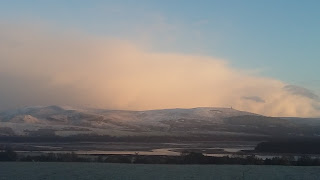
pictures! I live in the Scottish Highlands beside heather-covered hills and a
sea loch full of seals.
I’m a
writer and art photographer, the love of images inspires my writing. I think in
pictures! I live in the Scottish Highlands beside heather-covered hills and a
sea loch full of seals.
A sea loch, seals, hills… talk about idyllic! Liz kindly
sent a photo of the view from her writing window and I suspect I won’t be the
only one feeling a little jealous😊 But from this inspirational view, Liz has
written three novels.
She says, ‘The Wrong Envelope and The Wrong
Direction are romantic comedies set in 1920. The Unravelling is a
contemporary novel and this is the one I would like to focus on today. It
straddles different genres. It has a dystopian and speculative feel but crosses
over into women’s fiction. The novel would appeal to readers who enjoy dark
humour, like to think about things and wonder why life isn’t fun any more. It is
also an exploration of family life and how easy it is to live completely
alienated from what really matters.’
I found The Unravelling markedly different from her
other books, but in a powerful and thought-provoking way. She says, ‘I was inspired by a mixture of things: the joys and
frustrations of being a teacher and a mother, a search for my younger self and
also the refugee crisis. (You’ll have to read the book to find out how these
different threads intertwine!)’ What a tease she is!
I asked Liz what she enjoys the most about writing and
she says, ‘I love creating a world that I can escape into. And I love the fact
that once the world is created, it quickly becomes independent from me! For
example the characters start to tell me what they think about the plot and
sometimes it’s difficult to get them to behave in the way I want! So I have to
compromise which hopefully makes the story more interesting. Before I started
writing I used to hear other writers saying this, but I never believed them!
Now I know it’s true!’
So if characters take on their own lives, how does she
go about naming them? She says, ‘There are certain names that I hear and that I
immediately like. So when I come across them, I jot them down for future use.
For example, Bernard, the hero of my first novel, The Wrong Envelope was
inspired by a Frenchman that my grandmother had to stay on exchange about
eighty years ago! When he was first mentioned in a family anecdote, I thought
what a lovely sound the name had. Sometimes I think that a name can evoke a
character. I imagined that someone called Bernard might be exuberant and
enthusiastic, perhaps over-enthusiastic! And that suited my irrepressible
artist to a tee!’
I asked Liz what she finds challenging about writing
and she says, ‘I think finding a publisher is the hardest thing. When I wrote
my first novel, The Wrong Envelope, I was lucky to find an agent and
that was a massive help. They gave me a lot of advice on writing and editing.
Eventually, when they couldn’t place the novel with a publisher, we parted
company, but I felt as if I had served an apprenticeship which gave me the
skills and confidence to plough on and publish independently. Once I had
decided to do that, everything was easier than I thought it would be. There is
a massive amount of publishing help and advice available and I discovered that
I could go at my own pace and take one step at a time.’
So this lends itself to asking, if Liz could go back
in time, what would she tell her younger writing self? She responds, ‘I wanted
to write when I was four years old, but it took another forty years before I
dared to put pen to paper. So I would tell my younger self to be brave, but
also not to worry about not feeling brave! I think the writing process is
something that can’t be forced. We write when we are ready. I probably needed a
lot of different life experiences before I was ready to write.’
It's a good point and I’ve certainly learnt all sorts
from novels I’ve read, so I asked Liz which novel she loves and why. She says,
‘I have a few favourites but I think the one I have reread the most is The
History of Love by Nicole Krauss. It’s set in New York and I absolutely
love the main character who is both a grumpy old man and a wonderful romantic.
It’s one of those books that is a story within a story and there are plot
intrigues that hook me in every time.’
It's not a book I’ve read, so that’s another joining
my ever-growing TBR (to be read) list! I love personal recommendations but reviews
are another way of finding great books (please see my featured post about this),
but how many of us leave bad reviews? And how does it make the author feel?
I asked Liz whether she reads reviews left on her books, and how she
handles both good and bad ones. She says, ‘I always read my book reviews! I can
learn a lot about my readers that way, and what they like/don’t like about my
work. I think that everyone finds bad reviews difficult at the beginning. It’s
a matter of getting used to it. I’m sure most writers would agree that their
good reviews outweigh the bad, so one useful approach to a bad review is to consider
it as the review that tempers the good reviews and makes them believable.
Before I buy a book these days, I always read one good and one bad review about
it. If there are no bad reviews, I feel a bit suspicious! So as a writer, I try
and remember this.’
So reviews are a great opportunity to feedback to the
writer as well as the reader, but I wondered if Liz would like the opportunity to say anything
to her readers. She jumped at the chance and says, ‘I’m so delighted when
people buy and read my books. A book is only alive when it is being read and so
readers have a really important part to play in the creativity of writing –
they are the other half of the process, and the most important half. So I would
like to thank my readers for bringing the stories to life!’
How lovely! My final question was to ask if there was
anything else she’d like to share and she replied, ‘I think that everyone has a
story inside them and I would encourage anyone who enjoys writing to keep going
no matter what. It’s a matter of getting down a few words every day. It’s like
knitting a scarf – a few rows at time and the scarf is suddenly finished!’
Great advice indeed, thank you so much Liz!
Book review
And now onto my book review of The Unravelling. I
asked Liz for a tweet-sized quote from the book, tweet here
‘A
cappuccino.’ He spoke clearly but slowly, as if he was a stranger here.
‘One shot or two?’ He looked like a two-shot kind of guy.
He gazed at me with thinly veiled contempt. ‘Oh, you only get one shot.’
This is one of the opening lines and, for me, set the
scene, as I had no idea what was going on, and I do love that in a book 😍 The
questions started buzzing around my head but were forgotten as the next chapter
launches us into the everyday existence of our protagonist, Ella.
I had a lot of sympathy for this middle-aged lady, stuck
in a failing marriage and a job she hates, with a lot of regrets about the
choices she’s made. She accepts her lot though, until a sinister encounter at
the railway station on a Monday morning forces her to reassess her life and things
become decidedly strange from that moment on 😖
Liz has a wonderful way of observing the ordinary,
things I realised, somewhat guiltily, that I do too, like double-checking she’s
locked the car, making sure nothing’s on the backseat to attract thieves, even
the delight in finding an unspent parking ticket so she doesn’t have to pay –
it was brilliantly observed. These light touches happened throughout the book
and I thought her use of descriptive passages, such as the lino at work, or
using the photocopier, not only set scenes but added to the dreariness she experienced
day-to-day, which really resonated with me! This contrasts beautifully with the
nightmare encounters she’s forced to face every day for this pivotal week in
her life (and I’m so relieved I was reading them and didn’t have to experience them first-hand😱).
Ella, and all the characters around her, are
struggling with their own issues but the way Ella’s life unravels is unnerving.
Initially I thought she might be experiencing a nervous breakdown (and me along
with her😧) but the book moves through several characters’ points-of-view, so
you realise it’s not only Ella experiencing strange things. There are lovely
scenes with her granddaughter, juxtaposed with jarring scenes with the weird
‘Life coach’ who knows too much about her, including her own private thoughts. I
particularly disliked one of her neighbours – he put my hackles up and it
wouldn’t be polite for me to say what I wanted to do to him!
It’s a snapshot of suburban life and whether we’re
willing to accept the compromises we make. I loved how the book changed from
everyday normality into a dark, almost gothic, atmosphere and I found myself
wondering what I would do in similar circumstances.
I liked the short chapters too, so you could stop at
any time, but the hook kept me reading well into the night. I was puzzled and spooked,
then laughing and empathising, and this continued throughout the story. But I
finished the book cheering for the characters’ choices, relieved the story
lines tied up nicely, although I do still have questions about the dodgy ticket
inspector!
Liz has created a dark, psychological story that makes
you think, and the questions raised will stay with me for a long time to
come. I highly recommended The Unravelling to anyone who enjoys eerie tales, plotted
so well that they unnerve you. But beware, it might be a little uncomfortable if
you’re close to your own midlife crisis… don’t tell me I didn’t warn you 😂
Website: https://www.liztreacher.com/
Twitter: https://twitter.com/liztreacher
Facebook: https://www.facebook.com/LizTreacherAuthor
Instagram: https://www.instagram.com/liztreacher/
I'd love your feedback, so please leave me a comment (some browsers might not work, Google Chrome works best!) Thank you 😃
Enjoyed this post? Never miss out by following here