Author interview:

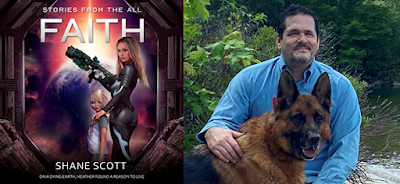
I’m delighted to introduce my second author to
Tweetables, Shane Scott, who writes stories featuring Gods, Devils, Dragons,
Werewolves, Demons, Titans, Vampires and Mortals. He released his first novel,
God of Nothing in 2021 and his novella, Faith, in February 2022. Both books are
set in the same ALL world and his writing genres are Fantasy, Science Fiction,
Post Apocalyptic and Dystopian.
Shane Scott didn’t start his working life as a writer,
instead he was a lifeguard, a flight instructor, and a bartender. He then spent
thirty years repairing computers and writing code. Nowadays he lives in Maine
with his cat, KooKooNut (and I love that name!).
I asked him what inspired him to write Faith and he
says, ‘I started thinking about my story in the early 1990s. I first tried to
write in 2008/2009 and then spent 10 years learning how to write a book. I
wrote Faith, a stand-alone novella when I started to have problems making
progress in my second novella, God of Everything.’ He aims to publish the latter
at the end of this year.
He continues, ‘I wrote Faith last summer/fall when I
kept finding myself working on books way up in the ALL series (God of Fire, God
of Blood, God of Evil) and not the next one, God of Everything. I wrote Faith
because my wife always asks if I planned to apocalypse the earth...and so, I
did.’
I couldn’t believe it had taken him over ten years to complete
his first book and he explained, ‘My first draft wasn't good. My house burned
down and I lost all of it. I then spent
the next ten years not only thinking about (and it kept getting bigger) but
also trying to write it. I invested a lot of time in how to write, the rules,
formats, etc.
I also wrote God of Nothing 4 different times in that
period with 1st person POV, radical changes, and I even hired a ghostwriter to
help me. None of those efforts produced
the book I wanted. I then took a dozen college classes over a couple years,
hired beta readers and an editor. That worked and I was able to rewrite the
entire story in 10 months, based 95% on the first draft I ever did. Same
characters, storyline, etc. I owe so
much to my editor Isabella.’
I was intrigued by how an editor could help so much
and he explained, ‘The biggest issue in writing is good writing vs bad writing,
Show vs Tell. That took me a long time to understand fully and Isabella
hammered it into my head. The same with
adverbs. I fought her every step of the way but she eventually made me a
convert. Adverbs add no meaning. For example, "Suddenly, I heard a noise
and quickly stood up and instantly went directly to the window and saw
zombies."
Everything that ends in LY in that sentence can get
removed and the sentence does not lose meaning. "I heard a noise and went
to the window." But Isabella would
make me rewrite anything like that to read, "Thunder boomed and I jumped
to my feet. I hustled to the window and peered out and gawked at the zombie
horde"
Isabella made me read a bunch of how-to books and gave
me line by line edits. I could never have finished God of Nothing or Faith
without her.’
She sounds a wonderful inspiration to him and what fantastic
advice for all of us writers.
Faith has some impressive-sounding technobabble,
feeding the futuristic feel, and I wondered whether this was something he’d studied
academically and he says, ‘I don't have a science background. I wrote code and
flew airplanes for my most of my life. I love science though, but I lack
whatever gene controls the ability to do the higher mathematics. From an early
age the "double slit experiment" fascinated me. I've set it up and
done. It kinda proves nothing is real unless observed by a conscious observer.
You can google it.’
I did, and I’m still not sure I understand!
He continues, ‘However all my concepts are grounded in
basic scientific fact. I obviously take some leeway here and there (Thedium, my
pretend element is made from spent emotions, dealt with in God of Nothing). So
the short answer is I made it all up and based it on scientific principles.
Quarks and Anti-Tau neutrinos are all part of the standard model of physics.’
It sounds very realistic to me but in addition to the
science, his ALL universe is complex, with a huge history and all sorts of technology.
I asked him how he manages all that information and he says, ‘It is all in my
head. I never once wrote an outline or spreadsheet. I am a panster.’ I take my
hat off to him!
So creating his universe has taken three decades and I
asked him what he would tell his younger self, and his answer was short and
sweet, ‘Start sooner!’
I then asked how he creates his character names and he
says, ‘First names come to me, I don’t give it much thought. Last names are a
problem and I have to read over lists of last names until I find one that is
right.’
When asked what he enjoys the most about writing, he
says, ‘Writing is hard work, thankless work. Finishing a full novel and having
it published is one of the best feelings a person can have.’
And what about the hardest part? He admits, ‘Marketing
is the biggest problem facing an indie author. I struggle to sell books and get
reviews.’
Receiving reviews seems to be one of the biggest
problems faced by authors trying to get their names out there, please see my
featured post on this issue, so I asked what Shane Scott whether he reads his reviews and what he feels about them. He says, ‘I do read the reviews for my books.
I’ve had 2 or 3 revenge reviews, one star type of thing from someone who had an
axe to grind. Those are part of publishing I guess. In general, I’ve had 4 and
5 star reviews and always read them to see what the reader thought. I want to
know what my readers think.’
So, as readers, we have the power to feed back to the
authors, as well as let other readers know how much we love their work. Shane
Scott confirms this in his message to you, saying, ‘If you read my books,
please, I beg you, leave a review.’ So could you do that for him? I’m certainly
going to and if you’re unsure how to start, please read my featured post by
clicking here.
I ended the interview asking if he had a favourite
novel and if so, why does he like it? He replies, ‘One of my favourite novels
is Amor, by John Steakley. The main character, Felix, has no redeeming
qualities yet at the end, you feel like you lost a friend.’
Book review
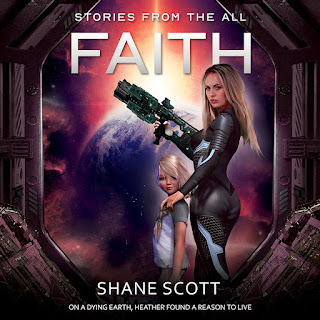
So now to the book review of Faith. I asked Shane
Scott for a tweetable synopsis of Faith (press to tweet)
The world burns and humanity teeters on the edge of
annihilation.
Heather fights for survival. After she rescues 8 year
old Sarah, everything changes A dystopian, postapocalyptic novella.
#IARTG #BookRecommendations
This sounds intriguing but for me, when I first got
the novella, the opening line was enough to hook me, ‘Bodies. Dead bodies.
Everywhere.’ Yikes! So something had radically changed to the Earth in the 1200
years until 3221!
It’s set in New England, or Masschester as it’s now
known, after a nuclear and an intergalactic war and ‘Brain Rot’ is now
prevalent. Some humans also suffer from the ‘brain-blast mutation’ which makes
their heads explode – nice! But the main outcome of his horrible disease is, ‘putrefaction
and death or bat-shit insanity after thirty-one days, four hours and eight
seconds’. Needless to say, those who are not infected battle to stay away from
the Rotters or Veiners and this novella follows one of these stories.
Heather, our protagonist, is foul-mouthed (bad
language alert!) but big hearted, and is world-weary, having little time for her
religious preaching work partner, Walter. Heather’s life changes forever when
she meets a young girl, Sarah, who is infected. Heather’s quick actions save
her from death and we then follow their story. Heather has her work cut out, battling
to protect her young charge whilst training her and looking for somewhere safe
to live.
The ALL universe is extremely well thought-out and I love the AI Kompter - who wouldn't want a computer that could heal you whilst talking to you telepathically at the speed of 'ten to the eighteen computations every second'?
Shane Scott had me laughing at the way language has
been handed down over the generations and has become (unknowingly but quite
humorously) misinterpreted. There is a lot of technical language used to convey
the story, highlighting how much backstory there is still to be told (no wonder
it’s a series). I found the book absorbing, fast paced and a fun ride. I finished
it wanting to read more, so God of Nothing is now on my TBR list, but Faith
is truly a standalone book - I didn’t feel like I was missing any pertinent
information.
I would recommend Faith to anyone who enjoys a pacy
plot with scifi/dystopian/ fantasy themes with a good sprinkling of humour. I
loved it!
Twitter: https://twitter.com/TheALLwriter
Facebook: https://www.facebook.com/TheALLwriter
I'd love your feedback, so please leave me a comment (some browsers might not work, Google Chrome works best!) Thank you 😃
Enjoyed this post? Never miss out by following here