AUTHOR INTERVIEW
I've a fun non-fiction book for you this month, from the super-adventurous Jackie Lambert who lives life to the full (so this article is longer than normal because she has so much to share!). Let's start by getting her to introduce herself to you:
'Hi, I’m Jacqueline (Jackie) Lambert, full-time traveller, author, adrenaline addict, wife of Mark and dogmother to The Fab Four, four Cavapoos (Cavalier/Poodle cross).
B.C. (Before Canines), I rafted, rock-climbed, and backpacked around six of the seven continents. A passionate windsurfer and off-piste skier, I can fly a plane, have been bitten by a lion, and appeared on Japanese TV as a fire-eater.
A.D. (After Dogs), I quit work to hit the road with my husband and The Pawsome Foursome. Initially, we were Adventure Caravanners, who aimed To Boldly Go Where No Van Has Gone Before. More recently, we are at large in a self-converted six-wheel army lorry, with Mongolia in our sights.
If you’re interested in my Adventure A-Z, from Abseiling to Zorbing, check it out here!'
She's created a tweetable for you here too (tweet here):
'Jacqueline (Jackie) Lambert is an award-winning author and real-life adventurer, who writes creative nonfiction with a humorous twist about Travel, Culture, and History, with Dogs.'
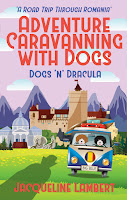
She writes light-hearted humorous travel memoirs/travelogues and has published 6 indie books since 2018. I've reviewed 'To Hel In A Hound Cart: Journey To The Centre Of Europe' and I asked Jackie what inspired her to write this book?
'It is the true story of our travels in 2020. We were locked down in Italy due to the coronavirus pandemic. With our house rented out and everything closed, we were unable to return home to the UK.
I wrote my Adventure Caravanning With Dogs series of books to inform and entertain. While they are humorous travelogues, which can be read purely for fun and enjoyment, I have also been asked many times how we gave up work to travel without a windfall or Lottery win, and to describe the warts-and-all realities of full-time van life.
2020 was certainly a challenging year to be a full-time nomad, although as legendary mountaineer Yvon Chouinard says, “It’s not an adventure until something goes wrong.”
Our travels are certainly adventures!'
I
can agree with that - I spent part of the book laughing, and part with
my heart in my mouth! What is it that makes her want to take such risks?
'I have loved excitement and adventure ever since I was a child, who climbed mountains with my Dad, rode horses bareback, and went scrambling on a bicycle my grandfather rescued from a skip.
I also loved writing about it. I penned my first travel memoir aged 14, about a 3-day horseback ride following ancient pack pony routes in the UK’s Lake District with author and radio presenter Bob Orrell. Bob entered my manuscript into a national competition open to all age groups, and it came second. I made the heady heights of an interview on Radio Blackburn.
 My first major solo adventure was a six-day descent of the Zambezi on the biggest white water in the world, with crocodiles, hippos (the most dangerous animal in Africa) and tropical diseases thrown in. Between the adrenaline, chilling by the campfire, sleeping under the stars, and glorying in a piece of nature that few people on earth will ever see, I was hooked. Pieces I wrote about some of these adventures have been featured in anthologies, alongside other bestselling and award-winning travel writers.
Since then, I have travelled as much as time and budget would allow, and have rafted major rivers on six continents. Like Toad of Toad Hall, I am a great dabbler, and have tried many things, from abseiling to zorbing, with jousting, flying, and skydiving thrown in, but my current favourite sports are skiing and windsurfing. I enjoy skiing off piste into the peace and remoteness of the back country, and have also windsurfed around the world with pro windsurfers and coaches in world-class locations like Maui, Venezuela, and Egypt. 
As a slightly overweight middle-aged lady, I was the most incongruous windsurfing Team Rider for the UK’s National Watersports Festival. I was also an ambassador for Ratoong, the No.1 website for finding the perfect ski resort. I have written blogs and articles on skiing and windsurfing for both organisations with a view to inspiring people, particularly ladies, to get involved with sports.
I have been a permanent nomad since giving up work in 2016, when hubs and I accidentally bought a caravan, got a little tipsy, then decided to rent out the house, sell most of our possessions, and tour Europe full time with our four dogs. Currently, we’re six years into our three-year trip and have no intention of stopping any time soon!'

'My approach to life is a little Ready, FIRE, Aim. I am impulsive and love to try new things, which means I don’t always fully think things through. I do stick to a few guiding principles, though. Two of these are, “What’s the worst that can happen?” and, “If you look at it and think you’re going to die, you probably will.”
Admittedly, the Zambezi defied both, although I didn’t realise that until I found myself in Harare airport watching a continuous reel of inflatable rafts and bodies being flung like rice at a wedding by churning white water. A fellow traveller revealed the river’s nickname was the ‘Slambezi’, but by then, it was too late to pull out!
Usually, things turn out better than you might imagine, although when things go wrong, my third principle is, “There’s always a solution.”
I was born with an adventurous streak and get a huge thrill from adrenaline. To be truthful, I also have a secondary motivation, and that is a huge a chip on my shoulder which arose because I don’t like to be underestimated.
As a female scientist who enjoys adventure sports, I have spent my life being passed over or dismissed because of my gender. It started when a careers adviser told me I could join the RAF but not as a pilot. “Training women,” he said, “is a waste of time and money, because you will only get married and have children.” A man who called me half way across the country to a Lab Manager interview on my day off said he had never had any intention of giving me the job for the same reasons, and added that he had just wanted to meet the pretty lady. I was flattered. When I told him how flattered, it probably reinforced his strategy of not employing members of The Tampax Team, a label applied to women in the workplace by another captain of industry I had the misfortune to meet.
I also want to inspire other women. So often, I hear, “I would love to, but I’m not good enough,” or “I could never do that!” When those ladies see a slightly plump grey nomad approaching her three-score on skis or a windsurfer, I hope they might re-evaluate their boundaries.
Rather than burning my bra, I prefer to lead by example. When they make assumptions about me, I rather enjoy shocking people into realising that I can understand technical things, fly planes, drive large vehicles safely, and be competent at sport.
Thankfully, my husband, Mark, doesn’t need educating in such matters. He is man enough to appreciate that I have a weight advantage on my windsurfer, so there’s no way he can catch me in light winds. However, the pool champion of North Wales now understands that he would not have been eight-balled by a woman if he hadn’t automatically assumed she couldn’t play.'
Wow! So what are her personal highlights and what adventures are still to be completed?
'A definite personal highlight for me was The Zambezi trip. It changed my life, because it truly awakened my wanderlust. The raw natural beauty, terror, and exhilaration of that trip made me realise there was so much more to life than work: eat: sleep: repeat. It set me on a course to discover how to incorporate more of what I love into my life.
I feel so fortunate to have learned that lesson at the age of thirty. The choices I made then mean I have been on many ‘trips of a lifetime’ since, and eventually achieved my objective of giving up work to travel. Of the trips Mark and I have undertaken together since quitting work, Romania really stands out. Her people are so kind and friendly, and the country is a relatively undiscovered gem, filled with beauty, pristine nature, and history.
As for adventures still to complete, there are so many. Mark’s question, “How would you like to ski down seven Chilean volcanoes for your fiftieth birthday?” prompted us to learn how to ski off piste. Our winter mountaineering skills aren’t up to ‘The Magnificent Seven’, yet, but the second choice, an ‘Introduction to Wavesailing’ windsurfing course on Maui, Hawai’i wasn’t too shabby. We only got two volcanoes, but imagine the almost spiritual experience of riding waves with Jurassic Park scenery, rainbows, and breaching whales as a backdrop.
We still want to drive our truck, The Beast, to Mongolia, although we will have to wait until things calm down in that part of the world. In the meantime, there is still everywhere. We haven’t been there yet!'
I don't think she'll ever stop! So what was it that motivated Jackie to become a published author and how did she transition from being a nomadic adventurer into an indie writer?
'I have always loved writing and in the early noughties, sought a career as a writer. I even gave up my job to make a go of it. My success was such that I could have wallpapered the house with the rejection slips, plus a few articles that magazines were happy to publish, but not pay for. I gave up on that dream.
Around 2008, I started to use Facebook to post about Mark’s and my adventures. My photos had rather more lengthy explanations than most, but many friends said they enjoyed my little stories and comments.
When we gave up work in 2016, it was not only our travels that intrigued my Facebook friends. They wanted to know how we’d pulled off quitting work at 50 without being millionaires, or winning The Lottery.
Brendan, a dog/campervan/windsurfing friend encouraged me to set up a blog, so World Wide Walkies was born in 2017. My aim was to entertain and inform, with stories of our travels and also how we did it. At last, I had a proper outlet for my writing and, as a bonus, it attracted readers from around the world
Late in 2018, a reader called Nicola commented,
“You should write a book. No-one writes like you. Even your blog about toilets was a joy to read.”
I explained how I had tried all that nonsense previously and got nowhere, but Nicola let me into a life-changing secret. She put me in touch with her friend, Sophie, who had self-published the Deerhound Rhodry series of children’s books.
I had never heard of ‘print on demand’ or ‘independent publishing’, but by December 2018, my first travel memoir, Fur Babies In France: From Wage Slaves To Living The Dream, was a Hot New Release on Amazon.
Nicola was thrilled. She admitted the second reason she wanted me to publish a book was because it would sort out her Christmas presents for that year.
So, thanks to Nicola’s Christmas shopping dilemma, I am now an award-winning indie writer who has published six books, based on my travel blog.'
Many indie authors hate promoting their work and with traditional routes sounding difficult for Jackie, how has she gotten her work noticed?
'A product without marketing is like winking at someone in the dark. You know what you’re doing, but nobody else does. Promotion and PR is relentless. It could easily become a full-time job and as an indie, I don’t have a huge budget or professionals to help me. The effort that goes into marketing depends on each individual’s objectives and definition of success. It’s not enough to have written a great book. To sell books, and keep selling them, consistent promotion and PR is a necessary evil.
‘Selling’ is often viewed as a bit of a dirty word, but I have an admission to make. I spent 25 years in field sales and marketing of scientific equipment, and never sold anyone a thing.
When I visited my customers, I got to know them and their businesses. I chatted to them about their families or pets, offered free training and technical support when they needed it, explained how they could comply with complex regulations, and was always at the end of a phone if there was anything they didn’t understand. Sometimes, I advised them not to buy from me, because I didn’t have the right product. In return, they were interested in me, my exploits on my travels, and hopefully enjoyed my visits as much as I did. Then, when they needed something or had a problem to solve, they called me because they trusted me. They knew I would provide exactly what they needed, perhaps not even at the lowest price, but at a fair price, which meant they were getting good value.
Selling is not about products, it’s about helping people: and particularly, solving their problems. You might say that ‘solutions’ are all very well for technical products, but how does that work for books?
During lockdown, ‘shelfies’ were popular. A bookshelf burgeoning with erudite books made an excellent backdrop for Zoom calls. However, most readers don’t buy books because they want a clod of bound paper they will never read gathering dust on their bookcase, or invisible kilobytes clogging up their e reader. The solution readers seek is escapism, entertainment, or learning. And when it comes to buying a book, they are more likely to buy from you if they know you and trust you. There is nothing more likely to turn them off than bombarding them relentlessly with media that says nothing more than, “Buy my book! Buy my book!” Authors who do that are not adding value.
As authors, we are creative writers. I have found that contributing guest posts, interviews, and networking with interest groups on social media has been the most effective PR. It takes time – and work – but in this life success rarely drops in your lap.
Kindness also makes the world go round, and it costs nothing! It’s not why I do it, because I believe kindness for kindness’ sake simply makes the world a better place, but I have found the more you help others, the more they help you – and the more doors open. I see book promotion sites full of people saying, “Buy my book! Buy my book!” and wonder how often these authors share somebody else’s work.
I am always happy to promote other authors’ work on my blog or social channels, or let them know when I find new marketing opportunities. After all, their readers might be my readers, and in the end, it helps us all. As a memoirist, one of the most helpful channels has been the Facebook group We Love Memoirs (WLM), set up and run by Alan Parks and New York Times bestselling author Victoria Twead. Self-promotion is strictly prohibited, other than at ‘parties’ a few times per year, where authors can run competitions and book giveaways.
So instead of “Buy my book! Buy my book!”, WLM provides a very well-run space for readers and authors to get to know each other and share stories, photographs, and experiences. WLM also hosts a very positive and supportive authors’ group, and a beta readers’ group, through which I have made many new friends.
Despite my background in sales, like most people, I feel a little uncomfortable about promoting myself and my own work. However, it has always been my belief that, if you have a good product that will benefit your customers, i.e. your readers, by entertaining, inspiring, or enlightening them, what is there to be embarrassed about?
My background in delivering presentations and training courses means I am accustomed to public speaking, although as a nomad, I can’t do personal appearances, talks, or signings. Nevertheless, I am comfortable with being interviewed for podcasts or on Zoom.'
How about reviews of her books - does she read them and how does she deal with bad and good ones?
'I go through phases of reading reviews, because it’s like holding a gun to your head in a game of Russian Roulette. I was so devastated when I received my first 1* review, I almost stopped writing for good. Now, I try to be sanguine, appreciate that not everyone will like what I do, and concentrate on the many more 5* reviews and all the positive feedback I receive. For the bad days, I keep a file on my computer entitled, ‘Kind Words’ to remind me of the good stuff.
I have been subjected to a small number of hurtful reviews, which were directed at me personally. One came from a friend of a friend because I turned down inappropriate advances he made toward me. I find it sad that people will target authors, and their potential to make a living, in this way.
It’s also a shame that some reviewers don’t make the distinction between, “I don’t like it,” and “It’s a terrible book.” I saw a scathing review of a memoir by a reader who said, “I usually read fantasy.” At least those who troubled to read the review would see the reader’s problem, but such careless reviews still bring down a book’s overall rating, and that can affect an author’s livelihood.
I’m a great believer in, “If you can be anything you want in this world, why not be kind?” If I don’t enjoy a book, I don’t review it.
Yet, poor reviews are a fact of life. Even famous and bestselling authors get them, and there will always be the anonymous trolls out there who are just plain nasty.
The other side of this is the incredible satisfaction I feel when readers have enjoyed my scribblings. A few have said my books have inspired them to travel, or given them courage to follow their dreams, as I have. When I get feedback like that, I feel my work is done!'
So, if anyone was to follow in her footsteps, what about the practicalities of a mobile life? For example, they must need addresses for banks or access to doctors, so does she have a ‘base’ and how did she return during lockdown?
'It is impossible to function in the modern world without an address. As you say, it’s a requirement for banks, insurance, medical care etc. We do own property, but it’s rented out to fund our travels, so we use a friendly relative’s address for the formalities. We have gone paperless with most things, but they open what little mail, we do get and let us know if there is anything that requires our immediate attention.
We have to return to the UK at least annually for an MOT – both for us and our vehicle. We have had to visit doctors, dentists, and opticians abroad. When we bought The Beast, Mark renewed his LGV licence in Italy. A fellow patient, a Canadian with an Italian wife, kindly translated the consultation for him.
The coronavirus pandemic did cause some issues, but as I am fond of saying, there’s always a solution. When the pandemic started in Europe, we were in northern Italy, in the epicentre. With our house rented out, campsites all closed, and many friends and relatives in the ‘vulnerable’ category, we couldn’t return to the UK because we literally had nowhere to go. Fortunately, we were able to stay in our rented Italian apartment.'
That was lucky! But what about personal possessions – how do they manage with so little room?
'We are ruthless about what we own and I have never felt happier. We have everything we need and are not weighed down by tons of excess baggage. It was a lesson I learned on the Zambezi that I value experience over owning tons of stuff.
The bulk of what we carry is ‘toys’ – windsurf boards and sails, SUPs, skis, bicycles, and doggie trailers. Mark and I own fewer than 10 kg of clothes each and have a One In One Out rule. When something wears out, we discard and replace it.
We carry most of our possessions in the truck. We sold almost everything in the month following our decision to travel. Mostly, it was a liberating experience, although shedding books and our record collection was painful. Spotify and a Kindle are fantastic space saving solutions, but lack the tactile and olfactory joy of dust jackets and vinyl.
Getting rid of the most deeply sentimental items was a process. For example, it took a few years before I could sell the rocking horse my grandad made for my fourth birthday. Eventually, I realised I had photographs and memories. I didn’t need the actual thing, which had been mouldering away in the loft for nearly half a century in any case.
We share half a garage with our tenant. The only things we have kept are paintings, because they are unique and irreplaceable, and it took many years to collect them.'
I think that shows how dedicated they are to their travels - I'm not sure I could be that ruthless (but I sense I should be!). Now, I'm sure you're wondering this too, but if they don’t often stay on traditional caravan sites, how do you get water or dispose of waste?
'With The Beast, we rarely stay on campsites. Her solar panels generate all our electricity, and we designed her to be fully self-sufficient for at least a month on water, fuel, and the LPG we use for cooking, heating, and hot water.
When we need facilities, we can find them easily using a number of very useful apps, such as Park4Night, Campy, and SearchforSites. These apps include traditional campsites and camper park ups, as well as facilities such as clean water points, grey and black waste disposal, launderettes, and showers.
Most Western European countries are very well set up for campers. For example, many towns and villages in France have free or low cost aires (‘areas’) for campervans and motorhomes, and municipal campsites for tents and caravans. Germany has the equivalent Parkplatzen, and Italy has sostas. Often, motorway service stations have water and waste disposal facilities for campers – and we found this even in Albania!
The Beast has a filtration system that allows us to refill from rivers or lakes if necessary, and we are just about to retro fit a composting toilet, which will remove the need for us to find black waste disposal.'
They really have thought of everything! How have the dogs taken to van-life and are there any legalities for foreign travel?
'The dogs have been travelling since they were a year old, so they are used to it. Dogs like routine, so travelling in a caravan or The Beast, their home remains constant.
The legalities of travelling with dogs mostly centres around breed-specific legislation and disease control, particularly rabies. Fighting or attack breeds, such as bulldog types (including Staffordshire bull terriers), mastiffs, Rottweilers, and akitas are banned from entering many countries. They may be permitted under certain conditions, such as being muzzled in public or registered on entry. With four Cavapoos (Cavalier/Poodle crosses), this does not apply to us.
Although
travel with dogs is relatively easy in the EU, there are countries to
which we couldn’t take the dogs. Iceland, for example, requires
quarantine regardless of vaccination status, China only allows a maximum
of one dog per adult to enter, and in parts of Iran, you can be
arrested for walking a dog in public, or even for having a pooch in the
car!'
** Jackie then gave a lot of technical information about pet passports/ vaccinations, etc - please go to the base of this post if you'd like to read more.
I ended by asking if there was anything she'd like to say to her readers?
'Thank you so much for buying my books, and for all your kind words and support. Writing is a lonely business, and we memoir authors bare our souls for your entertainment, so your appreciation is especially valued!
Do check out my blog for advice on full-time travel with dogs, and do drop me a line if you’ve any questions. If I can help anyone turn their dreams into reality, it will make me extremely happy!'
And on that lovely sentiment, I asked Jackie for a tweetable extract from her book (tweet here):
“It’s not an adventure until something goes wrong.” Yvon Chouinard, legendary mountaineer. This story is definitely an adventure!
'A true tale of a couple bound for Hel, Poland, with 4 dogs in their hound cart (RV). Between cliff-side roads, political unrest & a global pandemic, will they or their plans go to Hel in a Hound Cart?'
BOOK REVIEW
Having towed a twin-axle caravan in the UK, I was intrigued to read this non-fiction account of travelling across Europe with a van in tow. I was hoping for some fun but oh my goodness, I was not expecting such crazy adventures!
Their caravan experiences all manner of scrapes enroute - 'If we moved either forward or backwards, the rough rock would tear the caravan open like a sardine tin'.
They travel on roads not designed for towing - 'When we looked it up later, the Gorges du Verdon also appears on the Dangerous Roads website. I am fairly sure that whoever described the drive as ‘not for the fainthearted,’ was probably referring to navigating it with a car – not in a 5 m (16 ft) van with a 7 m (23 ft) caravan in tow'.
They encounter hairpin bends and sheer drops without safety barriers - I was on the edge of my seat!
Jackie has a lovely writing style and the book sits somewhere between being a travel guide, with lots of interesting facts about the places they visit, to a fun diary of their exploits which are always entertaining. It's very engaging and evocative, and I came away both amused and informed!
I certainly won't be retracing her tyre-tracks with a tourer (Covid times or not!) but I did enjoy accompanying Jackie, her husband Mark and their four cavapoos (aka The Fab Four) on their mad journey across Europe - it's a great read!
If you'd like to find out more about the author, please visit Jackie's links
below:
Enjoyed this post?
Never miss out by following here
** Continued from above - pet passports, vaccinations, and more technical information on taking pets abroad:
The
European pet passport system used to make life easy, since it allowed
microchipped dogs, cats, and ferrets who had been vaccinated for rabies
to cross borders without the need for quarantine. However, when Britain
left the EU, the UK/EU passport ceased to exist overnight. UK pets
without an EU passport now need an expensive and complex ten-page
bilingual Animal Health Certificate (AHC) for each entry into the EU.
The AHC is valid only for a single entry into the EU, and four months of
onward travel.
We foresaw some of the complications Brexit might
bring, so The Fab Four now travel on French/EU pet passports. The French
authorities have since made getting French pet passports more difficult
for non-residents, although some other European countries will still
issue passports to non-resident British pets. British vets can’t update
most sections of an EU pet passport without invalidating it, so The Fab
Four get their vaccinations administered in the EU. Otherwise, they
would still need an AHC to travel.
Even
within the EU, there are slight differences in entry requirements. Some
countries don’t recognise the validity of the 3-year rabies
vaccination, and require annual boosters. Others require an additional
rabies antibody blood ‘titer’ test to confirm that the rabies jab was
effective. For most, but not all countries, once the titer test has been
carried out, it remains valid so long as the rabies boosters are kept
up to date. AHCs, import permits, and additional vaccinations and
parasite treatments, such as tapeworm, are mandatory to enter some
countries.
The pet travel website (link here),
which lists the entry requirements for over 220 countries, gives an
indication of what to look out for. For the most up to date information,
I recommend checking the government websites for the countries you
intend to visit.
Besides
complying with entry requirements, we also make sure our pups are
protected against other diseases to which they may have no natural
immunity. We always check with our vet for the most appropriate
vaccinations and parasite treatments for the places we intend to visit,
regardless of whether it’s legally required.